
A Journalistic Thriller and Historical Drama
by Curtis L. DeBerg
About the Screenplay
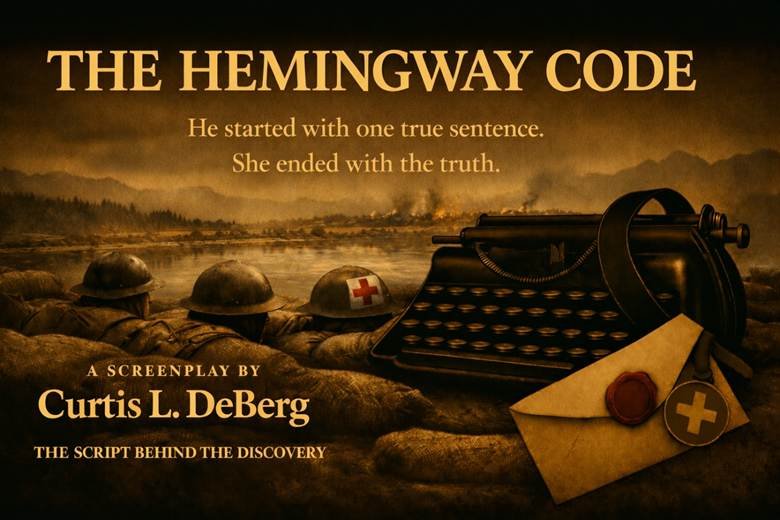
The Hemingway Code
In the final weeks of Ernest Hemingway’s life, a brief, dictated piece arrives at the Kansas City Star. It is not a confession. It offers no answers. Instead, it points the reader elsewhere—toward a war story Hemingway never told the same way twice.
THE HEMINGWAY CODE is a work of historical fiction inspired by that provocation.
The screenplay follows a modern journalist who begins tracing the contradictions beneath Hemingway’s celebrated World War I legend. Her investigation leads to a suppressed American Red Cross report and the erased death of an Italian infantryman, Fedele Temperini, who died during the same incident in which Hemingway was wounded at Fossalta in 1918. The report was written, filed internally, and never entered into the official record.
As poems, letters, late-life artifacts, and institutional procedures come into view, a pattern emerges: the truth was not disproven. It was excluded. Authority and consensus hardened omission into history.
Intercutting past and present, THE HEMINGWAY CODE is not a biopic and does not claim certainty where the historical record remains incomplete. Instead, it examines how institutions decide what counts as evidence, what is permitted to challenge an established narrative, and what quietly disappears.
The film ends not with resolution, but with placement—two names at the Piave River, not reconciled, not equalized, but finally acknowledged.
THE HEMINGWAY CODE asks a simple, unsettling question:
Who decides what survives as history—and at what cost?
For more information, see:

Casting Vision
Author Note on Fact vs. Fictional Elements
The “Sweden Event” MEDIA KIT
"THE WRITER'S STATEMENT"